


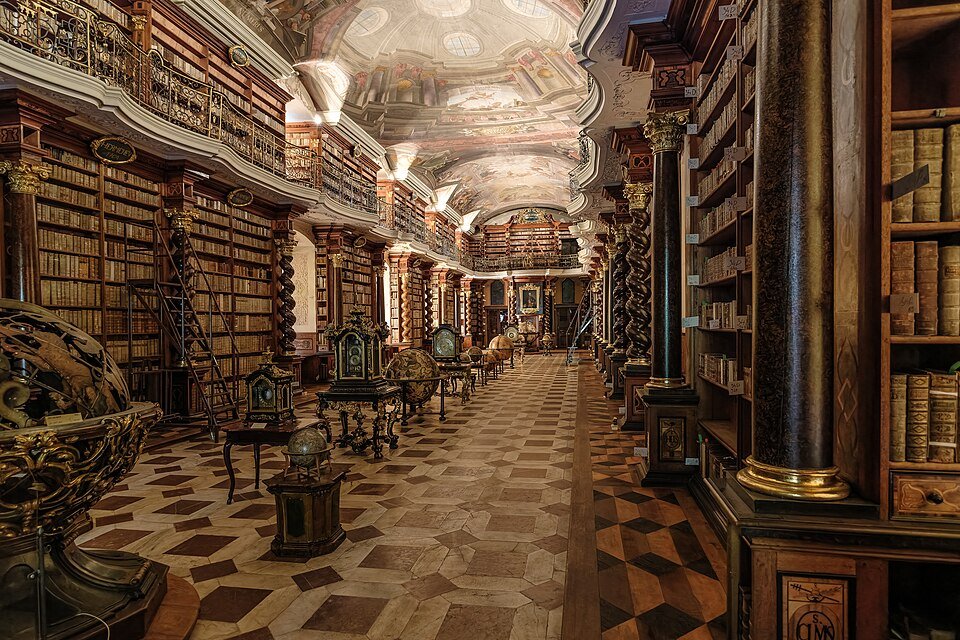
There is a room in the middle of Prague that thousands of people photograph every year and almost nobody has ever walked through. Two storeys of gilded bookcases, a painted sky on the ceiling and a row of antique globes standing on the floor like planets that wandered indoors. You reach it, you look, and then you are moved along. The rope stays where it is.
The room belongs to the Clementinum, the second-largest building complex in the city after Prague Castle and one of the strangest things hiding behind the Old Town’s façades. From Mariánské náměstí it looks like nothing much: a long wall, a gate, a courtyard. Behind it sits a small walled city built by the Jesuits, who arrived in 1556, took over the ground of a Dominican monastery dedicated to St Clement that had stood there since 1227, and then spent two centuries expanding in every direction they could.
Today it is the seat of the National Library of the Czech Republic, and the only way inside is a guided tour of about forty-five minutes. Three stops: the library you cannot enter, the room where noon was decided, and a tower you climb on foot.
The room you are not allowed to enter
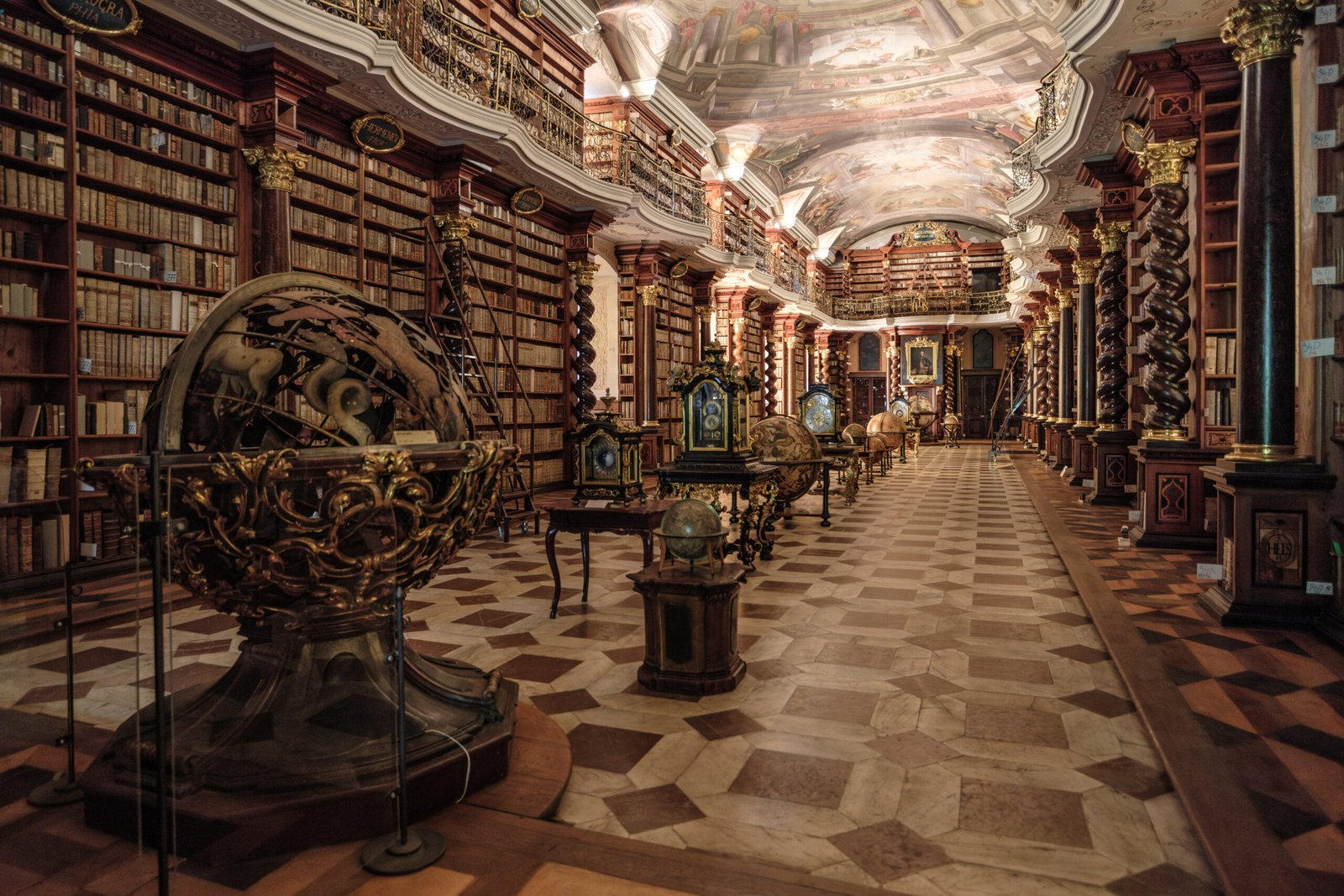
The Baroque Library Hall was finished in 1722 to a design by Kilián Ignác Dienzenhofer, the architect behind half the domes on the Prague skyline. Jan Hiebel painted the ceiling with allegories of learning and the arts, and the shelves hold roughly 27,000 volumes of early printed books. The globes in the centre of the hall are not decoration; they are working instruments from the era when this was a place of astronomy as much as reading.
Visitors see all of it from the doorway, and go no further. That single restriction explains something you may have noticed already: every photograph you have ever seen of this hall is taken from the same two square metres of floor. It also gives the room its peculiar spell. It looks less like a library than a stage set for one, permanently waiting for someone to come back and finish reading.
Where noon used to be decided
Two floors up, the Meridian Hall is the opposite kind of room: plain, functional and quietly astonishing. Two original mural quadrants are still fixed to the walls, built for measuring the positions of stars. The hall itself worked as a camera obscura, with light admitted through a small opening and falling across a marked meridian line. The moment the beam crossed the line was true noon — the signal the city set its clocks by, long before anyone could telephone the time.
172 steps
The Astronomical Tower is 68 metres tall, and there is no lift. A spiral staircase of 172 steps narrows as it climbs, and at the top a lead Atlas holds the celestial sphere on his shoulders above a gallery that looks across the Old Town roofs to the Castle and the river. Astronomers worked from here from around 1750 until 1938, when the lights of a growing city finally defeated them and the observations moved out to the observatory at Ondřejov, in the countryside south-east of Prague.
The longest weather diary in Europe
In 1775 an astronomer named Antonín Strnad began writing down the weather at the Clementinum, methodically, every day. Nobody has stopped since. Wars, empires and three changes of country later, the series is still running, and it is the longest unbroken record of its kind in Europe. When Czech television announces that a day was the hottest since measurements began, this building is where the measuring began.
A chapel made of mirrors
One more room is worth knowing about, though the standard tour does not include it. The Mirror Chapel has mirrors set directly into its stucco, so the decoration multiplies itself into the ceiling, alongside four paintings by Václav Vavřinec Reiner. It works today as a concert hall — which means the reliable way to see it is to buy a ticket for a concert rather than a tour.
Mozart played in the Clementinum on several occasions during his Prague visits. The Jesuit college that built all this was abolished in 1773; four years later the library opened to the public, and its holdings have since grown past six million volumes, almost all of them stored far from the room the visitors photograph.
How to visit
Tours leave from the ticket office beneath the Astronomical Tower, run in Czech and English, and take about forty-five minutes. Groups are fixed in size, so in the busy months it pays to book ahead.
| Ticket | Price |
|---|---|
| Adult | 380 CZK |
| Reduced (6–15, seniors 65+, ZTP) | 230 CZK |
| Youth 16–26 | 300 CZK |
| Family (2 adults + up to 4 children) | 810 CZK |
| Children under 5 | Free |
The first two tours of the morning are half price. They are also the quietest, which makes the early slot the best value of the day by some distance.
- Address: Mariánské náměstí 190/5, Staré Město, Prague 1. The entrance is the ticket office under the tower.
- Getting there: Staroměstská (metro line A) is a short walk; the complex sits between Charles Bridge and Old Town Square, so it slots neatly into the walk between them.
- Hours: Prague City Tourism, which runs the tours, lists 9:00 to 20:00 with changes over Christmas; the National Library lists 9:00 to 19:00. The last departure moves with the season, so confirm on the day.
- Access: the tower is stairs only, and they are steep and narrow near the top.
Check the Prague City Tourism listing or the National Library page for the current timetable before you go.
Related Reading
- Astronomical Clock Tower, Old Town
- Old Town Bridge Tower
- Petřín Tower and Mirror Maze
- 25 most important buildings in Prague
- Classical music in Prague
Photographs licensed under CC BY-SA 4.0, resized for the web with no other changes. Visitor information from the official Prague City Tourism and National Library listings, checked in September 2026.






[…] Clementinum […]